
The Solar Decathlon Shines on the Mall

This post was written by GoingGreenDC contributing writer Alison Drucker.

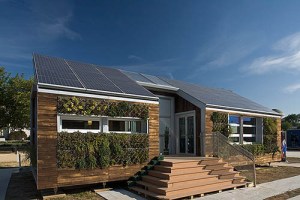
photo_gallery_austinFor a couple weeks in October, your regular jog around the Mall will look a little different. That’s when the Solar Decathlon comes to town, and 20 cutting-edge solar-powered homes descend on the Mall.

An educational project from the Department of Energy and its National Renewable Energy Laboratory, the Solar Decathlon is a competition among university teams from around the world to create the most efficient, attractive, and entirely solar-powered home. The teams spend almost two years designing and building their homes elsewhere, and transport them to the Mall to be rebuilt; the public is then invited to come tour, observe, and learn.

The challenge for participants is to create an efficient solar home that could actually serve the needs of a typical family, with all the modern conveniences, while being aesthetically striking. There are certain restrictions in place, such as a specified temperature range the homes have to maintain and types of equipment they have to power. Experts from DOE and NREL judge entrants in 10 categories, from architecture to market viability to home entertainment.

The homes generate energy with building-integrated (incorporated during construction) photovoltaic systems to produce electricity, and with solar thermal systems for space heating/cooling and water heating. The goal is a net-zero energy home that produces as much energy from renewable sources as it consumes. Teams come from as far as Germany and Spain, and as near as Virginia Tech and Penn State, to compete.
photo_gallery_montrealThe competition equips the student participants – future engineers, architects, builders, business owners, policy-makers – with the skills to make renewable energy, energy efficiency, and green building technologies part of their careers. It also teaches the rest of us about one of the world’s greatest challenges – our constantly increasing demand for energy and the need for sustainable solutions.

It’s well worth fighting the crowds to take a peek at the houses, with participating teams on hand to give insightful tours and explanations. The homes are open to visitors October 9-13 and October 15-18, from 11 a.m. to 3 p.m. Monday-Friday and 10 a.m. to 5 p.m. Saturdays and Sundays. You can also attend presentations in the temporary educational village (whose technology is powered by solar electric systems, naturally).

Green October

solar decathlonOctober may be the month known for pumpkins, costumes, and trick or treaters, but it’s also brimming with green events that you won’t want to miss.
Wednesday October 7th

Green Building Policy and Design: Best Practices from Switzerland

A panel of experts will discuss the practical aspects of constructing green buildings in the U.S. and Switzerland.

Cost: Free, but RSVPs are essential (email: was.scienceevents@eda.admin.ch)
Location: The Embassy of Switzerland, 2900 Cathedral Ave.
Time: 6 pm

Friday October 9th

Extreme Green Gala

The event, which benefits CarbonFree DC, will feature high-profile environmentalists, organic food, a $5 cash bar (beer, wine, whiskey), two live bands, and an environmental art show benefiting WVSA youth art program.

Cost: $25
Location: Mott House, 122 Maryland Ave NE
Time: 6:30-11:30 pm

October 9-13 and October 15-18

The Solar Decathlon

University teams from around the world compete to design and build homes that run entirely on solar energy. The teams ship their partially constructed homes to the National Mall, assemble them, and then compete in 10 contests.

Location: The National Mall

Saturday October 10th and Sunday October 11

The Green Festival

The granddaddy of green events returns to DC with more than 125 speakers and 350 green businesses, as well as how-to workshops, green films, a Fair Trade pavilion, yoga classes, organic beer, organic cuisine, and live music.

Cost: $15
Location: Washington Convention Center, 801 Mount Vernon Place, NW
Time: Saturday 10-7, Sunday 11-6

Thursday October 15th

Planting Empowerment Fundraiser

A happy hour to spread the word about Planting Empowerment, an organization that works with rainforest peoples in Panama to make conservation profitable.

Cost: $5 donation (includes free drink) or $10 (free drink plus an chance to win a $50 forest savings bond)
Location: Chi-Cha Lounge, 1624 U Street
Time: 5 to 8 pm

Saturday October 17th

Urban Composting

Put those worms to work and learn how to recycle your yard and kitchen waste, even if you don’t have a yard.

Location: Greater Goods, 1626 U Street NW
Time: 11 am

Friday October 23rd to Sunday October 25th

Introduction to Urban and Community Food Gardens

Spend a weekend learning the basics of urban gardening, garden design, and starting a community garden.

Location: Common Good City Farm, 2025 Elm Street NW
Cost:$200
Time: Friday, 6-9pm, Saturday, 9am – 5pm,  Sunday, October 25th 9-4

Yardshare and Share Alike

This post was written by Going Green DC contributing writer Alison Drucker.

The rewards of yard sharing. Fresh basil!

What’s a city apartment dweller with a green thumb to do? Find a neighbor willing to share some yard space.

Sharing Backyards is a national project that connects people with unused yards with others in their communities looking for a place to cultivate something. It encourages urban gardeners to make the most of limited green space, gives people a connection to the land, and expands access to fresh, local food – while uniting neighbors and beautifying urban space.

The D.C. area is full of yard-sharing success stories. One of those is the partnership between Patricia, a Rockville resident with a double lot, and Rebecca, a first-time gardener inspired by Barbara Kingsolver’s Animal, Vegetable, Miracle to reevaluate her food sources.

Patricia posted her spare space on the D.C. Sharing Backyards Web site and swiftly – within 15 minutes – received an email connecting her to Rebecca.

eHarmony couldn’t have done a better job matching the two. Rebecca found a gardening mentor in Patricia, and each found a good friend. A few patches of squash and tomatoes later, Rebecca had a new source of produce, which she happily shared with Patricia all summer. They didn’t have a formal arrangement for sharing the veggies, though some yard-sharing duos choose to lay down specific terms for who gets what and who supplies the tools, seeds, and soil.

Interested in yard-sharing? Use this online map to find a potential partner. If you’re in search of land, try to find a place close by, since tending a garden may become part of your daily routine – when it isn’t your own yard, you can’t just wander outside in your bathrobe to pull some weeds.

Grow Your Own

This post was written by Going Green DC contributing writer Alison Drucker.

Sometimes city life can leave you aching for fresh air – and fresh dirt. Not that grimy, stuck-to-the-bottom-of-your-shoe city dirt, but clean-smelling, produce-cultivating countryside dirt.

Get your hands dirty at Clagett Farm, a sustainable vegetable farm in Upper Marlboro, MD, owned and operated by the Chesapeake Bay Foundation. Any able-bodied person can sign up to volunteer picking produce on the farm on Tuesdays through Saturdays. At least four hours of labor will get you the same full weekly share of fresh, local vegetables that a Community Supported Agriculture (CSA) member receives.

The workshare is perfect for anyone who isn’t ready to commit to an entire season’s worth of harvest through a CSA membership, or who just wants to go learn about sustainable farming on a beautiful fall morning. Clagett Farm isn’t certified organic, but follows organic standards and doesn’t use genetically modified seeds.

In addition to doing good for the planet, the farm does good for the community. Almost half of Clagett Farm’s produce is distributed free or at a reduced cost to low-income DC communities in cooperation with the Capital Area Food Bank, expanding access to the fresh, healthy foods we all need in our diets.

Visit the Clagett Farm Web site to learn about participating in a workshare. Saturday workshares require calling ahead to sign up. Call 301.537.3038 between 8 a.m. and 4 p.m. a couple of days before the Saturday you want to work.

There’s still time to volunteer this season – September, October, and November bring broccoli, kale, cabbage, butternut squash, pumpkins, sweet potatoes, salad greens, carrots, turnips, collards, chard, spinach, and more.

If you’re adventurous in the kitchen and willing to explore new recipes as different fruits and vegetables are in season, purchase a 2010 CSA membership. Email clagettfarm@cbf.org to be notified when shares are available, and join the farm to get weekly batches of the season’s harvest.

Connecting Farms to Schools

IMG_0264This post was written by contributing writer Andrea Northup.

Imagine the following scenario:

Jenny is one of many schoolchildren in DC who receives free or subsidized meals at school every day.  One day, she finds a fresh, juicy slice of watermelon grown on a farm in Maryland on her cafeteria tray.  She meets the farmer who grew the fruit and learns about how the watermelon started as a seed, grew, and made it to her tray.  Jenny and her classmates participate in a cooking demonstration with a local chef using fresh, seasonal ingredients.

This scenario will be a reality during Local Flavor Week (September 21-25), when schools in DC will serve locally grown produce and offer educational opportunities for students, including produce tastings, cooking demonstrations, and farmer visits.

The event kicks off efforts to bring Farm to School programs to DC. The goal is to link schools with local farms in order to serve healthy meals in school cafeterias, improve student nutrition, provide health and nutrition education opportunities that will last a lifetime, and support local small farmers.

With the start of the school year, school lunch is at the forefront of everyone’s minds. Farm to School programs are popping up across the country. It’s time for DC — with the White House Garden in our midst, and farms in the surrounding region looking for stable markets – to become a leader in the Farm to School movement.

IMG_0421Local Flavor Week is organized by the DC Farm to School Network in partnership with the Capital Area Food Bank, the National Farm to School Network, the Office of the State Superintendent of Education, Whole Foods, and other community partners.